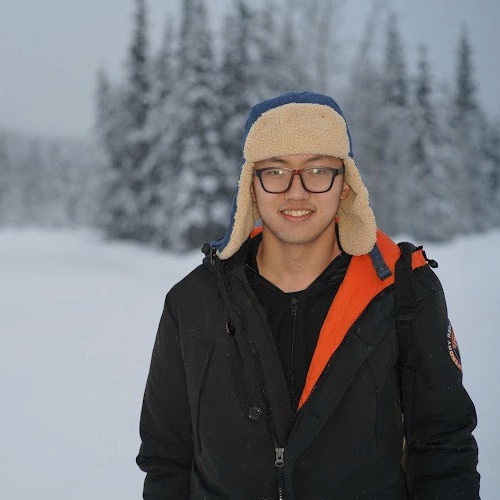
Wenrui Jiang’s websites
Welcome! I am carving my name on a tree trunk in the vast forest that is the internet. Thanks for reading this (many years later, perhaps) and thanks for taking an interest in me.
My name is Wenrui Jiang (姜文瑞), and I am a postdoc in Gaël Forget’s group as MIT. I finished my Ph.D. in 2025 as a member of Tom Haine’s group at Johns Hopkins University. My main interest is in physical oceanography (see Research overview below), and I love to think about problems in fluid dynamics, modeling, geophysics, mathematics, and many other related topics.
In my free time, I like to run, swim, ride a bicycle, paint, cook, and play the harmonica (this does not imply that I am any good at those things). When I was a kid, I wanted to become a Formula 1 driver or a battlefield journalist. Well, I picked up physical oceanography now… Anywhoo, I am enjoying my time as a student learning about the ocean, and would like to get better at it.
Enough of “I me mine”. Let me know something about you. You can find my contact information on the left side panel.
Reasearch overview
佛观一碗水,八万四千虫。The Buddha looks at a bowl of water and sees eighty-four thousand worms. —《毗尼日用》
The most fascinating aspect of the ocean for me is its vast range of scales and the surprisingly many ways that small scale affects large scale. The dynamics of each scale are vastly different from one another, and so much is unknown.
My most recent project is on the interactions between inertial gravity waves and upper ocean submesoscale filaments, which is at about the smallest scale possible for rotation and stratification to matter. This study is still ongoing, but I already have some nice-looking plots.
Jumping to the largest scale of the ocean, I am also interested in the Atlantic Meridional Overturning Circulation, or AMOC. It is arguably the most important circulation to watch under anthropogenic climate change. We just submitted a paper about the freshwater variability of the Eastern Subpolar North Atlantic. (Yes, quite a very specific Atlantic indeed.)
I have developed a method that closes tracer budget on Lagrangian particles, which is inspired by the Green’s function methodology. It has proven to be a invaluable tool for understanding large-scale ocean heat and freshwater anomalies.
I am avid in developing open source software. I am the main contributor to the Python package seaduck and the poseidon viewer. Seaduck can be used for interpolation, Lagrangian particle simulation, and closing budget on Lagrangian particles. Poseidon viewer is a visualization tool for a high-resolution global simulation called LLC4320.